Electronic Product Design and Development: UK Guide
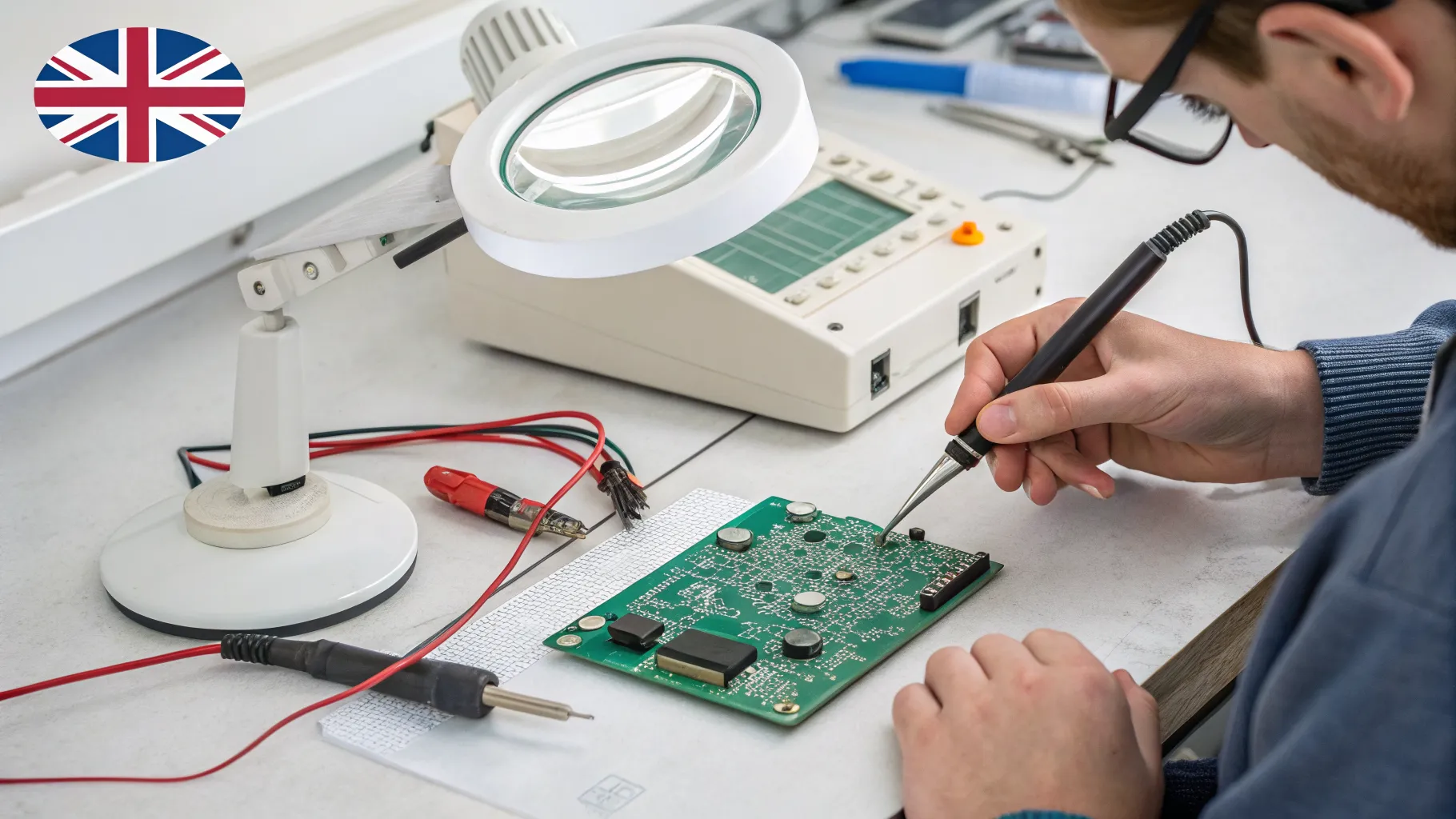
Electronic product design and development is the work of turning an idea into a manufacturable circuit board, a working enclosure, firmware that runs it, and a paper trail that lets you legally sell it in Great Britain. Most teams underestimate three things: how much firmware costs relative to the hardware, how long the cycle actually takes, and how easily one end-of-life component can force a redesign after the tooling is paid for. This guide gives you the real numbers, the current UK compliance position, and the decisions that decide whether a project ships on budget.
What the full cycle actually costs in the UK
A typical UK electronic product runs from the tens of thousands into six figures end to end, depending on complexity and whether it talks wirelessly. Simple, wired products sit at the lower end. Anything with a radio, a custom enclosure, and non-trivial firmware climbs quickly, and genuinely complex products can pass the £300,000 mark across a full cycle.
The cost is spread unevenly across stages. Roughly, a UK project breaks down like this:
- Feasibility study: the smallest line item, confirming the concept is buildable and roughly costed before you commit.
- Schematic and PCB development: a large and variable band, driven by layer count, component density, and signal speed.
- Prototype build (3 to 5 units): modest compared with the design work, because the boards themselves are cheap once designed.
- Hardware testing: mid-range, and it grows with the number of test cycles you need.
- Compliance and certification testing: charged per region, so selling into more markets multiplies it.
- Enclosure tooling: often the single biggest one-off cost if you need injection-moulded parts.
UK consulting electronics engineers typically charge in the low-to-mid hundreds of pounds per hour, so the design phase is mostly skilled labour, not parts.
Firmware is the headline cost, not an afterthought
Here is the figure that catches most first-time hardware founders off guard: embedded software commonly costs two to four times the hardware. A hardware design that costs £40,000 can easily need £80,000 to £160,000 of firmware to make it actually work, connect, update, and behave reliably in the field.
Consultancy service pages tend to bury this because it is awkward to quote. Plan for it from the start. If your product has a radio, a user interface, over-the-air updates, or any cloud connection, the software is the project. Budget the firmware before you fall in love with the hardware spec.
How long it takes
Expect 4 to 12 months from concept to a working prototype, depending on complexity. A full hardware cycle run by a complete team, taking the product from concept through to production readiness, is roughly 6 to 9 months. The classic failure is assuming a “lean” 2 to 3 month build, then discovering that firmware integration, compliance testing, and design iterations each take longer than the optimistic plan allowed.
The board fabrication itself is not the bottleneck. Small prototype runs ship in a few days for very little money. The time goes into design, debugging, iteration, and getting through certification.
The build phases: prototype to PVT
Hardware does not jump from a breadboard to a factory. The recognised phases each answer a different question:
- Prototype: does the core idea work at all? Often hand-assembled, frequently on a development board.
- EVT (Engineering Validation Test): does the actual designed hardware meet the engineering spec? First real PCBs in a representative form.
- DVT (Design Validation Test): does it meet every requirement, including mechanical fit, thermals, and compliance pre-checks? This is where you freeze the design.
- PVT (Production Validation Test): can the factory build it consistently at volume, with the same quality, on the real production line?
Skipping or rushing these phases is how problems that cost pennies at EVT become recalls at production.
Compliance: the current UK position for 2026
There are four regulatory frameworks you need to know for selling electronics on the GB market:
- Low Voltage rules covering basic electrical safety.
- EMC (electromagnetic compatibility), so your product neither emits nor is disrupted by interference.
- Radio Equipment Regulations (RED) for anything with a radio.
- RoHS and REACH, covering hazardous and restricted substances.
Two points trip people up. First, marking. The Product Safety and Metrology etc. (Amendment) Regulations 2024, effective 1 October 2024, confirmed that businesses can use either CE or UKCA marking on the GB market beyond 31 December 2024, with no current end date for CE acceptance. So in 2026 you are not forced onto UKCA; CE is accepted indefinitely as things stand. Check the live position before you commit, because policy can change.
Second, wireless. If your product contains a Bluetooth, Wi-Fi, or cellular radio, the RED applies and the EMC Directive does not apply separately, because RED already covers both radio and EMC. Do not pay for and document EMC compliance twice.
Keep your records. Under the EMC Regulations 2016, manufacturers must hold the technical documentation and the Declaration of Conformity, and retain those records for 10 years. Treat the paperwork as part of the deliverable, not an extra.
For the primary sources, see the GOV.UK guidance on using the UKCA marking and the Electromagnetic Compatibility Regulations 2016 (Great Britain).
The end-of-life component trap
One of the most expensive failures in hardware has nothing to do with the design being wrong. A component goes end-of-life after your tooling is complete, you cannot buy it any more, and you are forced into a redesign that delays launch by months. IPC guidance recommends validating each component’s lifecycle against your expected production horizon before you finalise the bill of materials. If a chip is already mature and the manufacturer is hinting at obsolescence, design it out now. Second-source the critical parts where you can.
Choosing your tools: KiCad or Altium
You do not need to buy expensive software to start.
| KiCad (v9) | Altium Designer | |
|---|---|---|
| Cost | Free, open-source | Commercial licence |
| Best for | Startups, prototyping, 2 and 4-layer boards | Market-scale products, high-speed, RF |
| Strengths | Capable, well supported, no licence cost | Advanced stackups, controlled impedance, integrated supply-chain and BOM tools |
| Limits | Strained by high-speed, RF, controlled-impedance and rigid-flex | Cost and learning curve |
KiCad is the sensible default for a first board and handles modest routing density well. Move to Altium when the product reaches market scale or when you hit high-speed, RF, or supply-chain management needs that KiCad struggles with.
For the brains of a connected prototype, the ESP32 or ESP32-C3 from Espressif is the common starting point: a low-cost Wi-Fi and Bluetooth SoC that pairs naturally with a first KiCad board. For non-trivial embedded products that do not need built-in radio, the STM32 ARM Cortex-M family from STMicroelectronics is the workhorse. Stick to standard FR-4 substrate unless you have a specific reason not to; exotic substrates raise both cost and lead time.
Design for manufacture starts on day one
Design for manufacture (DFM) means designing the board and enclosure so a factory can actually build them at volume, cheaply and consistently. It is not a step you bolt on at the end. The teams that overrun are the ones that ignore per-unit and BOM cost during design, then discover at PVT that the product is too expensive to make or too fiddly to assemble. Bring manufacturing constraints into the first schematic review, not the last.
Common reasons hardware projects overrun
- Assuming a 2 to 3 month timeline for something that needs 6 to 9.
- Treating firmware as a small add-on when it is the biggest cost.
- Budgeting for one design iteration when real products need several.
- Ignoring per-unit and BOM cost until production, then redesigning for margin.
- Finalising the BOM without checking component lifecycle, then redesigning around an obsolete part.
- Documenting EMC separately for a wireless product already covered by RED.
Can you do it yourself, or do you need a consultancy?
If you have an electronics engineer in-house, a first prototype on KiCad with an ESP32 or STM32 is well within reach, and prototype PCBs are cheap. The point where most teams bring in a UK design consultancy is the jump from a working prototype to a certified, manufacturable product: high-speed layout, compliance strategy, enclosure tooling, and DFM. Decide honestly which side of that line your team sits on before you start, and read our companion pieces on choosing a PCB design tool and preparing for UKCA and CE compliance.
Frequently asked questions
How much does it cost to develop a new electronic product in the UK? A typical end-to-end project runs from the tens of thousands into six figures, and complex products can exceed three hundred thousand across a full cycle. The spread depends mainly on complexity, whether the product is wireless, and the firmware load, which often costs two to four times the hardware.
How long does electronic product development take? Plan for 4 to 12 months from concept to a working prototype. A full hardware cycle with a complete team, taken through to production readiness, is roughly 6 to 9 months. Board fabrication is fast; design, iteration, firmware, and certification take the time.
Do I need UKCA or CE marking to sell electronics in the UK in 2026? You can use either. The Product Safety and Metrology etc. (Amendment) Regulations 2024, effective 1 October 2024, confirmed that CE marking is accepted on the GB market beyond 31 December 2024 with no current end date, so UKCA is not mandatory. Always confirm the live position on GOV.UK before committing, as policy can change.
What compliance does a Bluetooth or Wi-Fi product need? A product with a radio falls under the Radio Equipment Regulations (RED). Because RED already covers both the radio and electromagnetic compatibility, the EMC Directive does not apply separately. You will still need to hold technical documentation and a Declaration of Conformity, retained for 10 years.
Why is firmware more expensive than the hardware? Software has to handle connectivity, the user interface, updates, error states, and field reliability, and that work scales faster than the circuit design. Across UK projects, firmware budgets commonly run two to four times the hardware cost, so a £40k hardware design can need £80k to £160k of software.
Should I use KiCad or Altium? Start with KiCad: it is free, capable, and fine for 2 and 4-layer prototype boards. Move to Altium when you reach market scale or hit high-speed, RF, controlled-impedance, or supply-chain management needs that KiCad handles poorly.
More from Experimento
related resultsBest A/B Testing Tools in 2026, Compared by What They Actually Do
A practical 2026 comparison of the best A/B testing tools by what each one is actually good at, from Optimizely and VWO to GrowthBook and PostHog.
read result →A/B Testing Tools Compared: Which Platform Fits Your Team
A/B testing tools compared for 2026: VWO, Optimizely, AB Tasty, Convert, GrowthBook, Statsig and PostHog, matched to marketing, CRO and engineering teams.
read result →Data-Driven Design: Let Research Guide Your Product Decisions
A practical guide to data-driven design: how to pair analytics with user research, run honest tests, and make product decisions on evidence, not opinion.
read result →