VWO and AB Tasty Relaunch as One Platform: Wingify
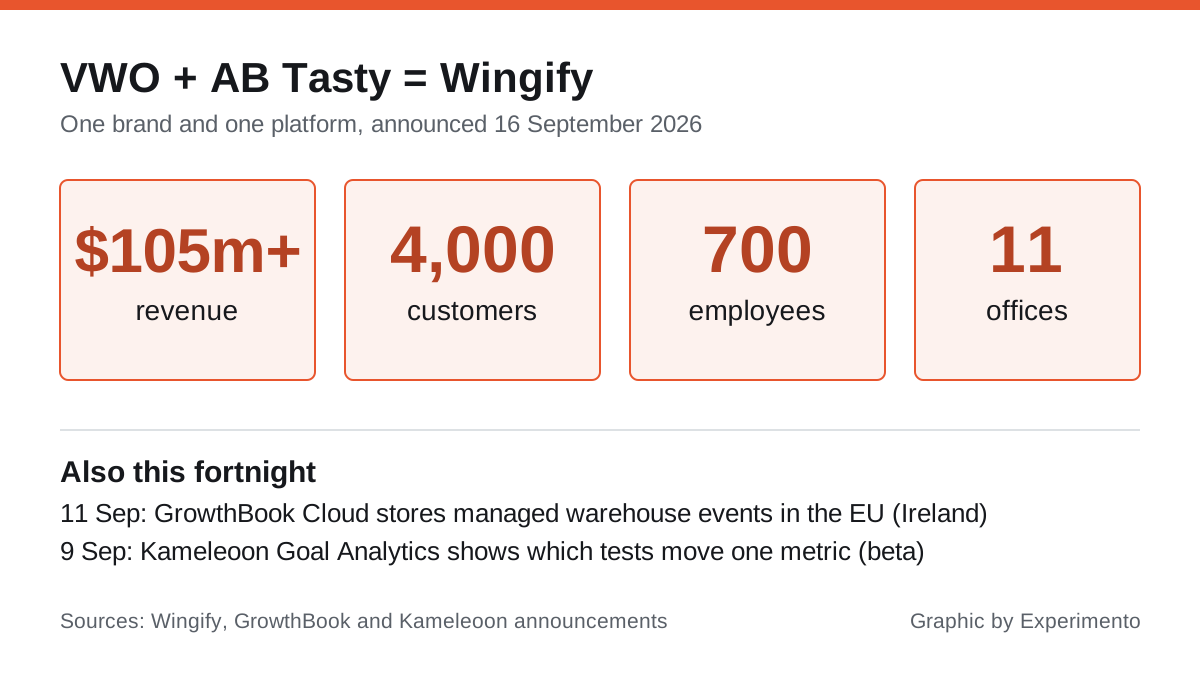
Three updates from the first half of September that change something practical for testing teams. The VWO and AB Tasty merger now has a single brand and platform, GrowthBook now lets European teams keep hosted event data in the EU, and Kameleoon has shipped a view that answers the question every experimentation lead eventually gets asked: which tests moved the number I own?
VWO and AB Tasty now sell as one platform, under the Wingify name
On 16 September Wingify announced that VWO and AB Tasty, which agreed to merge in January, now operate under one brand and one platform. The company says it launches with more than $105 million in revenue, 4,000 customers and 700 employees across 11 offices. Named customers carried over include L’Oréal, LVMH, Decathlon, Puma and Forbes.
The platform puts experimentation, personalisation, customer insights, commerce optimisation, feature management and customer engagement on a shared data foundation. Wingify calls the approach “Agentic Experience Optimization”, and its AI engine, Wingz, which was first introduced in August, is meant to work inside a four-stage loop: understand the visitor, decide the next experience, act while they are still on the page, then measure the result against business goals.
The announcement says nothing about pricing, plan changes or when either legacy product might be retired, only that customers are not being asked to start over. If you are on VWO or AB Tasty with a renewal coming up, that is the conversation to have before signing a multi-year term: which product your contract now covers, and what happens to your existing tests and integrations if the roadmap merges. Treat any AI that “acts while the visitor is still on the page” the same way you would a multi-armed bandit: it can lift a metric, but it will not give you a clean, repeatable read on why, so keep controlled A/B tests for decisions you need to defend. Our VWO vs Optimizely comparison and Optimizely alternatives are the places to start if you are reviewing the shortlist. The announcement is on Wingify’s newsroom.
GrowthBook Cloud adds an EU data region for managed warehouses
On 11 September GrowthBook added an EU data region to GrowthBook Cloud. If you use its Managed Warehouse, you can now choose AWS eu-west-1 in Ireland, and event data is ingested and stored in the EU. It is available on every GrowthBook Cloud plan.
Be precise about what moves. Event ingestion and storage sit in the EU. The GrowthBook application itself, meaning login, the interface, your configuration and the computed experiment results, stays in the US. GrowthBook says only configuration metadata and aggregate results cross the border, and its Data Protection Addendum and Standard Contractual Clauses are unchanged. Teams that connect their own warehouse were never sending raw events to GrowthBook in the first place, so this release is for teams who want GrowthBook to host the data.
For UK and EU teams this can remove a data-location objection in procurement reviews for the hosted product. Whether it is enough depends on whether your data protection review treats aggregate results held in the US as acceptable; check that with whoever signs off before you move. The managed option also gives smaller teams a warehouse without a data engineer, with tables for events, experiment exposures and feature flag usage and three starter metrics. Our A/B testing tools comparison covers how GrowthBook’s warehouse-native model differs from the rest. Details are on GrowthBook’s blog.
Kameleoon adds a Goal Analytics page that ties tests to one business metric
On 9 September Kameleoon introduced Goal Analytics, a page that takes a single business metric and shows which experiments are affecting it, in which direction, with a confidence indicator for each. It also brings together health KPIs, a daily events timeline with anomaly detection, and goal metadata. Alongside it, the app home page can now show embedded dashboard views and health checks, so a newly launched test that is recording no conversions is visible straight away.
Kameleoon’s reasoning is that teams using AI to build tests are running more of them with less engineering time, which makes it harder to know whether someone else’s experiment is dragging down a metric you own. Both features are in public beta and will reach all Kameleoon users in the coming weeks, according to the company.
A metric-first view is useful, with one caution. Adding up the measured effects of individual winning tests almost always overstates the real impact on the metric, because of winner’s curse and interactions between tests, so use the page to spot conflicts and broken tests rather than to report a total uplift. A conversion-free test is also often a tracking or allocation fault; run it through our sample ratio mismatch calculator before you trust anything it says. For the programme side, see how to build a CRO programme. The update is on Kameleoon’s blog.
More from Experimento
related resultsBest A/B Testing Tools in 2026, Compared by What They Actually Do
A practical 2026 comparison of the best A/B testing tools by what each one is actually good at, from Optimizely and VWO to GrowthBook and PostHog.
read result →A/B Testing Tools Compared: Which Platform Fits Your Team
A/B testing tools compared for 2026: VWO, Optimizely, AB Tasty, Convert, GrowthBook, Statsig and PostHog, matched to marketing, CRO and engineering teams.
read result →Data-Driven Design: Let Research Guide Your Product Decisions
A practical guide to data-driven design: how to pair analytics with user research, run honest tests, and make product decisions on evidence, not opinion.
read result →