Optimizely Hack: Test Snippets Served Malware to 178 Firms
This week’s four experimentation stories, from 13 to 19 November 2026, are led by the attack on Optimizely Web, which on 16 November turned the A/B testing snippets of 178 organisations, including Zoom, the BBC and HSBC, into a way to deliver malware. The other three are new releases: Statsig’s Agent Experimentation, LaunchDarkly’s Release Autopilot and percentile metrics, and a free GrowthBook route to feature flags for coding agents.
Optimizely Web snippets served malware for most of a day
On 16 November an attacker exploited a flaw in the signup flow for Optimizely’s Web Experimentation product. Optimizely says the attacker used it to impersonate users on targeted customer accounts and put malicious JavaScript into those customers’ projects, in Project JavaScript, the field where customers add their own code to run on every page. Because the code then shipped inside each customer’s normal snippet from Optimizely’s own CDN, browsers ran it as trusted.
The security researcher Scott Helme’s company, Report URI, which first spotted it, checked 1,611 Optimizely snippets and found the code in 188 of them, belonging to 178 organisations. Its list includes Zoom, the BBC, CNN, Salesforce, GitLab, IKEA, HSBC, Equifax and Air France-KLM, and it says the real number is likely higher. The injected script swapped crypto wallet addresses, skimmed card numbers typed into a site’s own form fields (cards entered in hosted payment frames such as Stripe were out of reach), took cookies and screenshots, and loaded iOS exploit kits on older iPhones. Report URI found it in only 1 of the 188 snippets by 21:52 UTC that night, and all of them clean by 23:11 UTC. The attacker’s wallets took about $7,040 that day.
In its statement on its status page, updated on 18 November, Optimizely says it closed the flaw within three hours of detecting it, that no malicious code remains in its systems, that it was not a credentials breach, that fewer than 5% of its customers were affected, and that no other Optimizely product was hit. It has contacted every Web Experimentation customer directly.
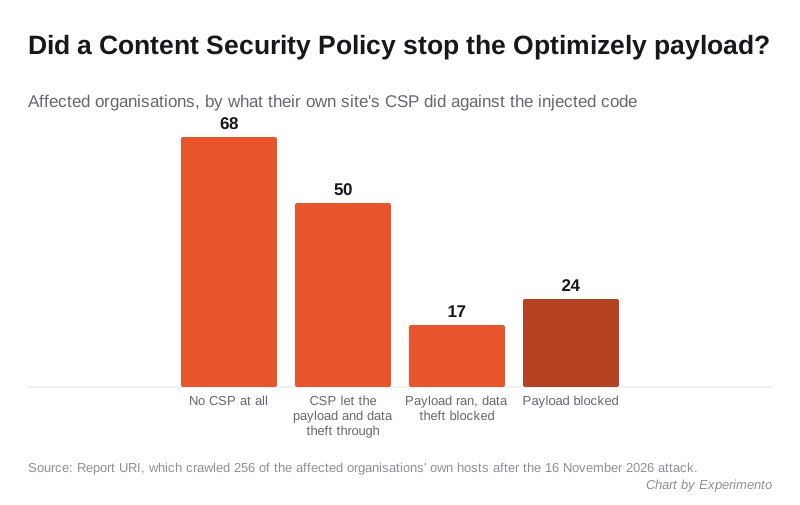
The chart above is the lesson for anyone running a client-side testing tool, whichever vendor. Report URI crawled 256 of the affected organisations’ own hosts. Only 24 had a Content Security Policy that blocked the payload; 68 had no policy at all. Allowing cdn.optimizely.com was no help, because the code came from that trusted host. What worked was a tight script-src listing only the hosts a site needs. Two common settings let the code through: 'strict-dynamic', and 'unsafe-eval', which Report URI notes Optimizely’s own documentation tells customers to allow. At HSBC the policy blocked the main script, but an inline copy still ran through eval. Another 17 sites restricted connect-src, which stopped card and cookie theft but not the wallet address swapping, because that happens inside the page.
If you use Optimizely Web, check every project’s Project JavaScript and each experiment’s custom code for anything you did not write, review who and what can write to the account, and rotate credentials. GrowthBook, a competitor, used the moment on 18 November to set out which of its own settings limit the damage, such as an SDK switch that skips experiments with custom JavaScript and read-only API keys; the questions it suggests asking any vendor are worth putting to yours. Our Optimizely alternatives and A/B testing tools comparison cover which tools inject code into the page and which only serve data. Read Report URI’s full write-up, Scott Helme’s follow-up on third-party scripts, BleepingComputer’s report and GrowthBook’s response.
Statsig: A/B test an AI agent, not just its eval score
On 17 November Statsig made Agent Experimentation available to all its customers. It starts from a problem many teams building AI features will recognise: an eval score goes up while the product metrics go down. Statsig’s answer joins four steps in one place. AI configs version a prompt, model and settings the way you would version an A/B variant. Offline evals grade those versions against a shared dataset with LLM judges or known good answers. Online evals score live interactions, and a failed one can be added straight from its trace to the dataset. Experiments then compare agent versions with real users, with evaluator scores shown next to task completion, conversion or retention.
The useful part is that last pairing. If evaluator scores improve but customers do not get more done, Statsig’s advice is to question the dataset, the evaluators or your idea of quality, rather than ship. Agent tests tend to have noisy outcomes, so size them like any other test with our sample size calculator. Read the launch post and the product update.
LaunchDarkly: Release Autopilot, and percentiles over every event
LaunchDarkly’s documentation changelog records three changes this week. On 16 November it published documentation for Release Autopilot, a set of features on select plans that reviews each pull request, recommends a flag and release plan, wraps risky changes in a flag after you approve, releases them one environment at a time, then opens a pull request to remove the flag and archives it. It is aimed at teams whose AI agents write more code than people can review flag by flag. It is not available on LaunchDarkly’s EU or federal instances.
On 17 November LaunchDarkly renamed data saving mode the Runtime Delivery Network and removed its Early Access notices. That matters for the flag overrides we covered last week, which let you change a flag from a local file when LaunchDarkly cannot be reached: they require the Runtime Delivery Network, which is no longer marked Early Access and is switched on in your SDK configuration, though overrides themselves are still marked experimental.
On 19 November it added event-level percentile metrics for Snowflake warehouse-native experiments. Instead of averaging each user’s values first, the P99 or median is taken over every event, which suits page load or search times where one user makes many requests. LaunchDarkly’s own example shows the difference: for three users making nine searches, the event-level median is 110 milliseconds, while the median of the three per-user averages is 373. The limits are long: no Bayesian analysis, bandits, guarded rollouts, CUPED or outlier capping on these metrics. See Release Autopilot, event-level percentiles and the changelog.
GrowthBook: feature flags for coding agents with no account
On 16 November GrowthBook published a guide for adding feature flags through a coding agent using its free, open-source SDK and a local flags.ts file, with no GrowthBook account, API key or flag server. The agent writes the rules in your repository, and the SDK handles the part teams often get wrong when they build it by hand: giving each user the same variant on every visit, so a shopper who refreshes halfway through paying stays in the checkout they started in, and keeping the original group in when you widen a rollout from 20% to 50%. Typed flags mean a misspelled flag name fails in TypeScript before it ships.
The catch is the one GrowthBook names: changing a local flag means a deploy, so if the person on call cannot wait for one during an incident, the flag needs to live in GrowthBook Cloud or a self-hosted server. A flag split in code is also not yet an experiment; you still need a metric and a test duration before calling a winner. Read the GrowthBook post.
Also this week
PostHog’s changelog for 13 November says it fixed a billing bug: local evaluation cache hits for feature flags, which were never billed, now count as one flag request each. If your servers poll for flag definitions often, check the Usage tab in PostHog’s feature flags. See PostHog’s changelog.
More from Experimento
related resultsBest A/B Testing Tools in 2026, Compared by What They Actually Do
A practical 2026 comparison of the best A/B testing tools by what each one is actually good at, from Optimizely and VWO to GrowthBook and PostHog.
read result →A/B Testing Tools Compared: Which Platform Fits Your Team
A/B testing tools compared for 2026: VWO, Optimizely, AB Tasty, Convert, GrowthBook, Statsig and PostHog, matched to marketing, CRO and engineering teams.
read result →Data-Driven Design: Let Research Guide Your Product Decisions
A practical guide to data-driven design: how to pair analytics with user research, run honest tests, and make product decisions on evidence, not opinion.
read result →